Building an evidence-led foundation for a public energy platform
Low Carbon Contracts Company (LCCC) operates at the centre of the UK’s transition to low-carbon energy. Through schemes such as Contracts for Difference (CfD), it helps enable billions of pounds of investment into renewable generation while supporting a complex network of market participants, policymakers, and industry stakeholders. When I joined the organisation, the challenge was not a lack of ideas. It was a lack of shared understanding. Different teams held different views of who users were, what they needed, which journeys mattered most, and how success should be measured.
What began as a programme of UX improvements became a broader effort to establish the foundations for evidence-based product decisions. Over twelve months I introduced audience segmentation, journey mapping, discovery practices, measurement frameworks, information architecture improvements, design standards, and governance structures designed to connect user needs with business outcomes.
The result was not a single feature launch. It was the creation of a decision-making spine that the organisation can continue to build upon long after my departure—one that also creates the conditions for more effective and responsible use of AI across products, content, and service delivery.
Task
Create the strategic foundations needed to understand audiences, identify opportunities, measure success, improve user experiences, and prepare a complex product estate for future AI-enabled ways of working. This involved defining audience models, mapping critical journeys, introducing measurement frameworks, establishing design standards, improving information architecture, creating governance mechanisms, and linking business strategy to a more evidence-led product roadmap across multiple products and services.
-
Strategy
Audience Strategy Product Strategy UX Strategy Journey Mapping Continuous Discovery Measurement Frameworks (HEART & CASTLE) AI Readiness Foundations Design Governance Information Architecture
-
Design
UX Research Service Design Information Architecture Interaction Design Design Systems Foundations Pattern Libraries Workshop Facilitation Opportunity Framing Concept Development
-
Client
Low Carbon Contracts Company (LCCC), Government part owned energy organisation, Public Services / Energy Sector. Net Zero 2050.
-
Role
Lead Product Designer.
-
Duration
2024 – 2025.
-
Focus
Billing Statement Flow, Scheme Operations (Settlements).
-
Impact
30 % faster reviews · 0 % data mismatches · Improved user confidence.
How I connected audiences, journeys, measurement and design standards to improve decisions today and prepare for more responsible AI use tomorrow
Between late 2025 and mid-2026, I helped LCCC’s Web Presence team move away from reactive web delivery and towards a more evidence-led product practice.
The organisation was entering a period of growth. Its public-facing estate already stretched across the corporate website, dashboards, registers, a Data Portal, allocation-round microsites and adjacent operational tools. At the same time, the business was exploring how digitalisation and AI could help it scale more effectively.
That created a broader design challenge than a website refresh.
The immediate need was to improve how people found information, understood complex services and moved between products. The longer-term opportunity was to make the estate more legible, measurable and governable, so that future AI-enabled experiences could be introduced with a clearer sense of purpose and a stronger basis for deciding where they would genuinely create value.
Rather than beginning with speculative AI features, I focused first on the conditions that would make AI useful.
I led a connected programme of work spanning audience discovery, user intent, content structure, critical journeys, information architecture, measurement, continuous discovery and design-system foundations. The result was not a single redesign. It was a stronger basis for deciding what to improve, how opportunities should be shaped and how the organisation could evolve its product estate without losing sight of the people using it.
Designing for a distributed public-energy ecosystem
of renewable electricity generation
Contracts for Difference
estimated private investment
Public datasets
year terms
LCCC operates at the centre of a rapidly evolving energy landscape.
Its role is not limited to a single scheme, technology or website. The organisation supports a widening portfolio that includes Contracts for Difference, the Capacity Market, carbon capture, low-carbon hydrogen, regulated infrastructure and emerging levy mechanisms.
The scale is substantial. In Allocation Round 7 and AR7a alone, LCCC signed more than 200 Contracts for Difference representing 14.7 GW of renewable electricity generation across fixed-bottom and floating offshore wind, onshore wind, solar and tidal-stream power. Those contracts will be managed over terms of 15–20 years.
The offshore-wind projects secured through the round were also reported to unlock an estimated £22 billion of private investment.
The public-facing estate reflects that complexity.
LCCC publishes role-based guidance, FAQs, official registers and a substantial set of interactive dashboards. The CfD dashboard area alone includes a dozen views covering allocation rounds, levy rates, historical data, operational costs, supplier payments, locations, determinations, in-period tracking, key dates and forecasts.
Alongside this, the Data Portal provides 38 public datasets, downloadable in CSV and JSON formats, with API access and update notifications for users who want to follow particular datasets or publishers. While some may see this as a conventional corporate website, It is a distributed information ecosystem supporting people with very different levels of knowledge, responsibility and intent at varying times.
- A generator may need to understand an upcoming allocation round, then move through award, onboarding and long-term contractual obligations.
- A supplier may need to interpret levy rates and forecast payments.
- An analyst may move from a dashboard into a downloadable dataset.
- A journalist or policy stakeholder may need an authoritative record.
- A member of the public may simply be trying to understand what LCCC does and why it matters (because our work affects them).
The estate had grown organically over time. Content structures reflected BAU demand. Navigation often reflected internal ownership. Audience definitions varied across teams. Measurement was limited, and responsibilities were not always explicit.
The visible friction was fragmented journeys. The deeper issue was ambiguity.
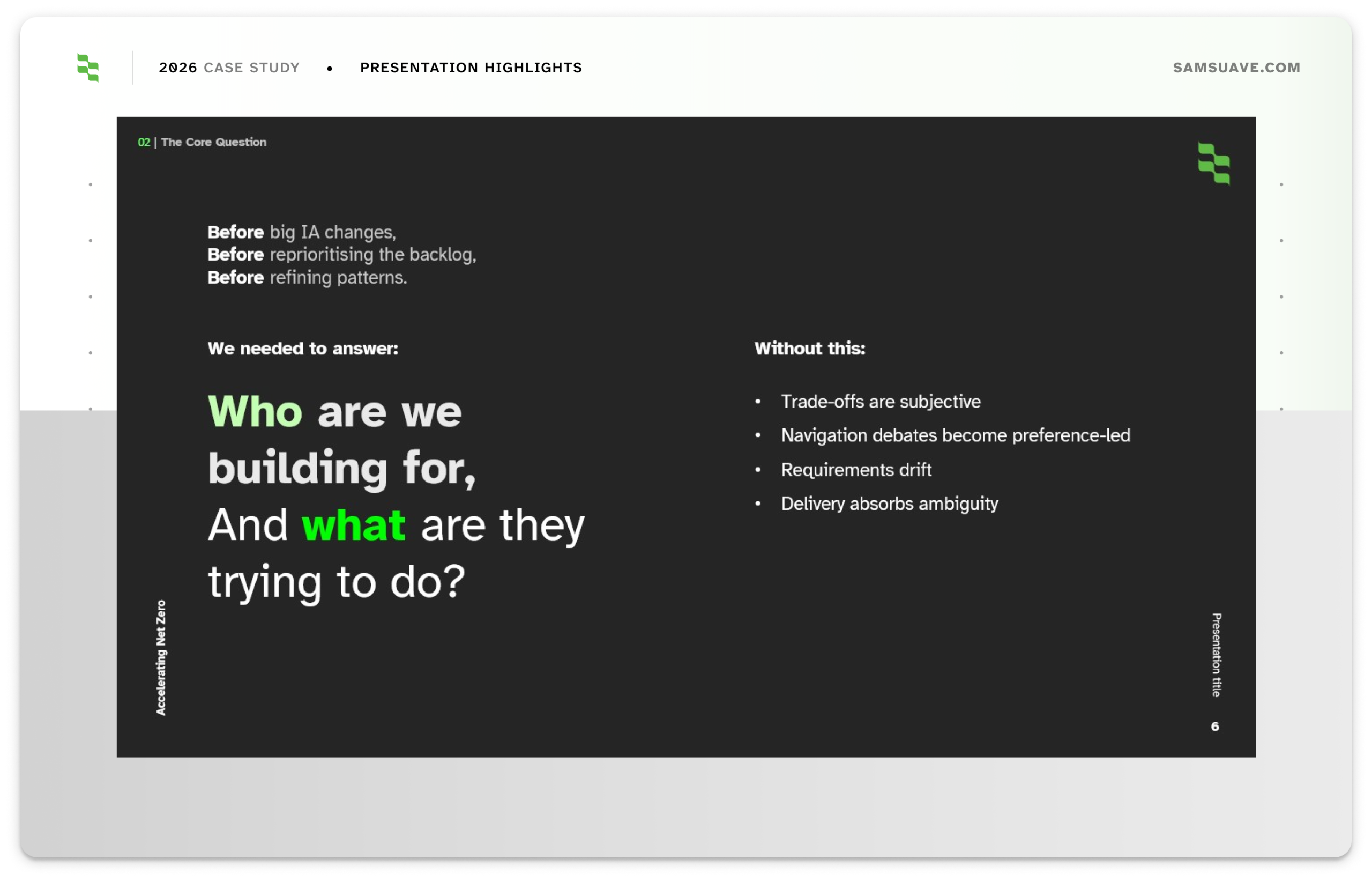
Without a clearer understanding of audiences, needs and outcomes, trade-offs remained subjective. Navigation conversations could become preference-led. Requirements drifted. Delivery teams absorbed uncertainty. New ideas, including AI ideas, risked being framed around novelty rather than meaningful value.
My previous work on Zero and Settlements had already shown me the importance of baselining user experience in complex operational products. When I moved into Web Presence, I saw an opportunity to establish a comparable foundation across the wider public-facing estate.
Decision 1:
Build a decision-grade baseline before jumping into solutions
Before redesigning navigation or refining components, I wanted the team to answer a simple question:
- Who are we building for, and what are they trying to do?
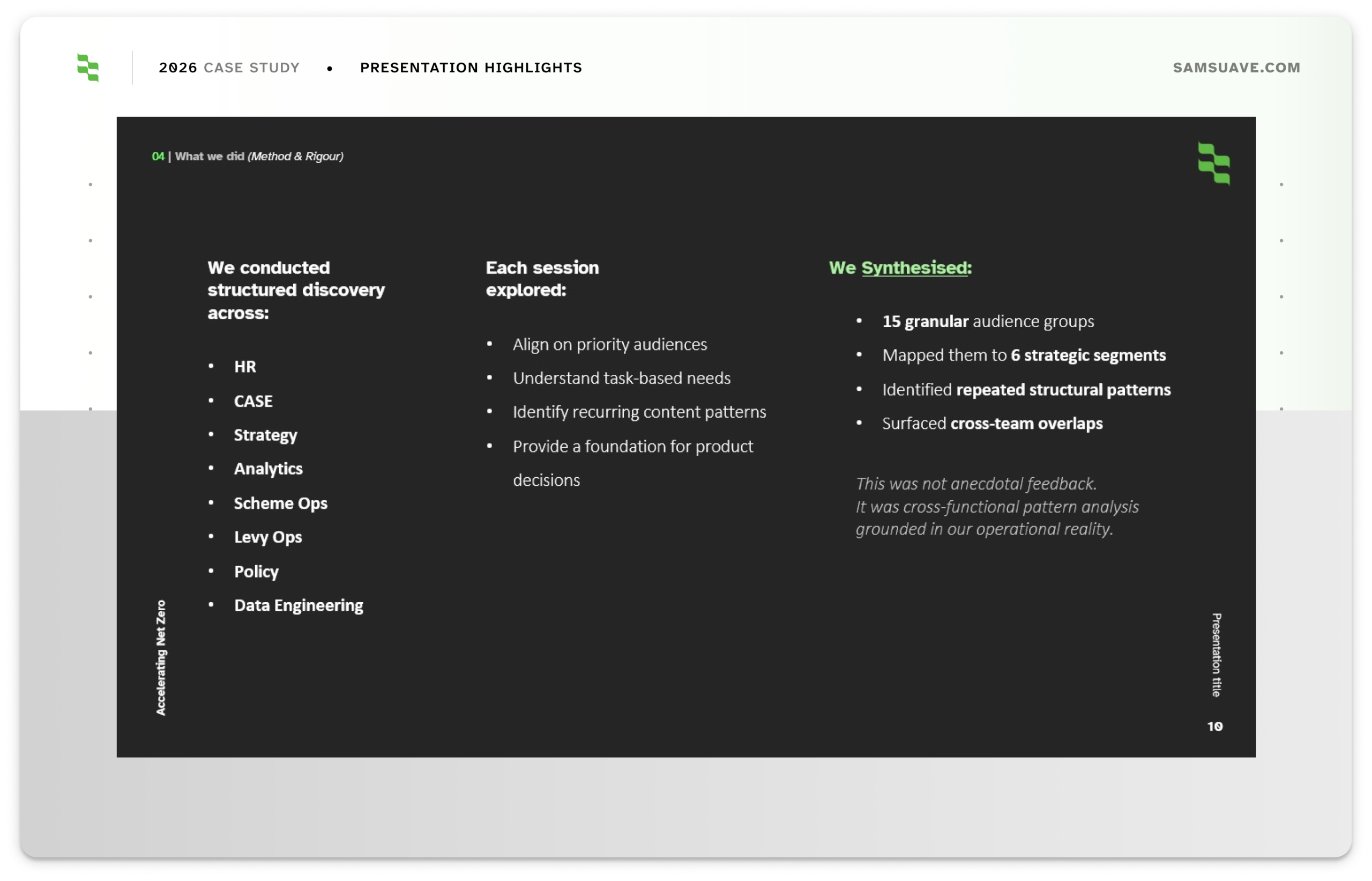
- I initiated Content Discovery across HR, CASE, Strategy, Analytics, Scheme Operations, Levy Operations, Policy and Data Engineering.
- The aim was not to create a static set of personas or a large content inventory. It was to translate distributed organisational knowledge into a more useful product model.
I shaped the interview guides, recruitment materials, facilitation approach, synthesis structure, findings reports and stakeholder presentations. This gave us a clearer view of the audiences Web Presence served, the tasks they were trying to complete and the structural barriers getting in their way.
From broad business segments to useful product context
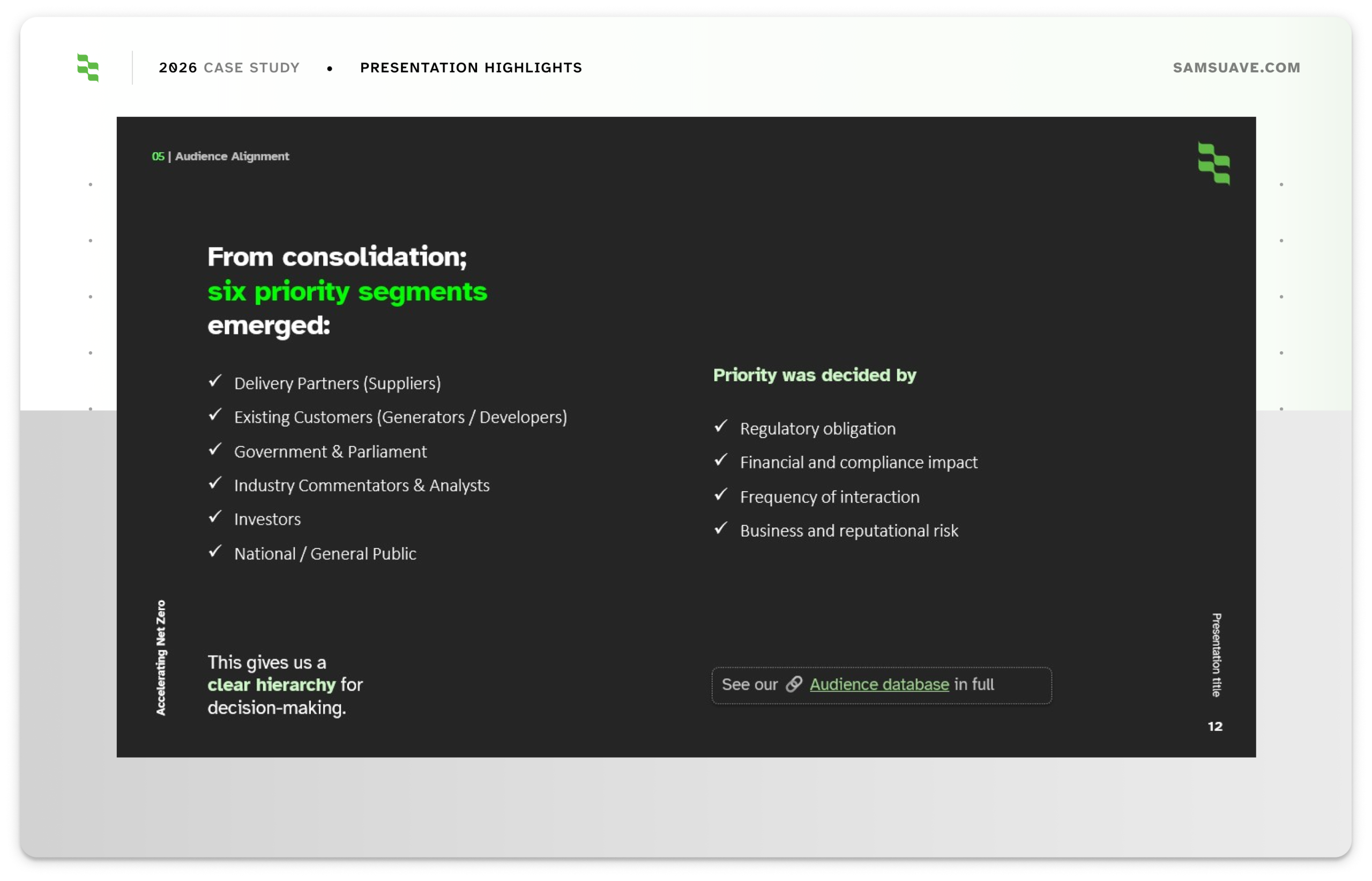
The organisation already had high-level audience categories. These were useful for strategic direction, but too broad for product decisions.
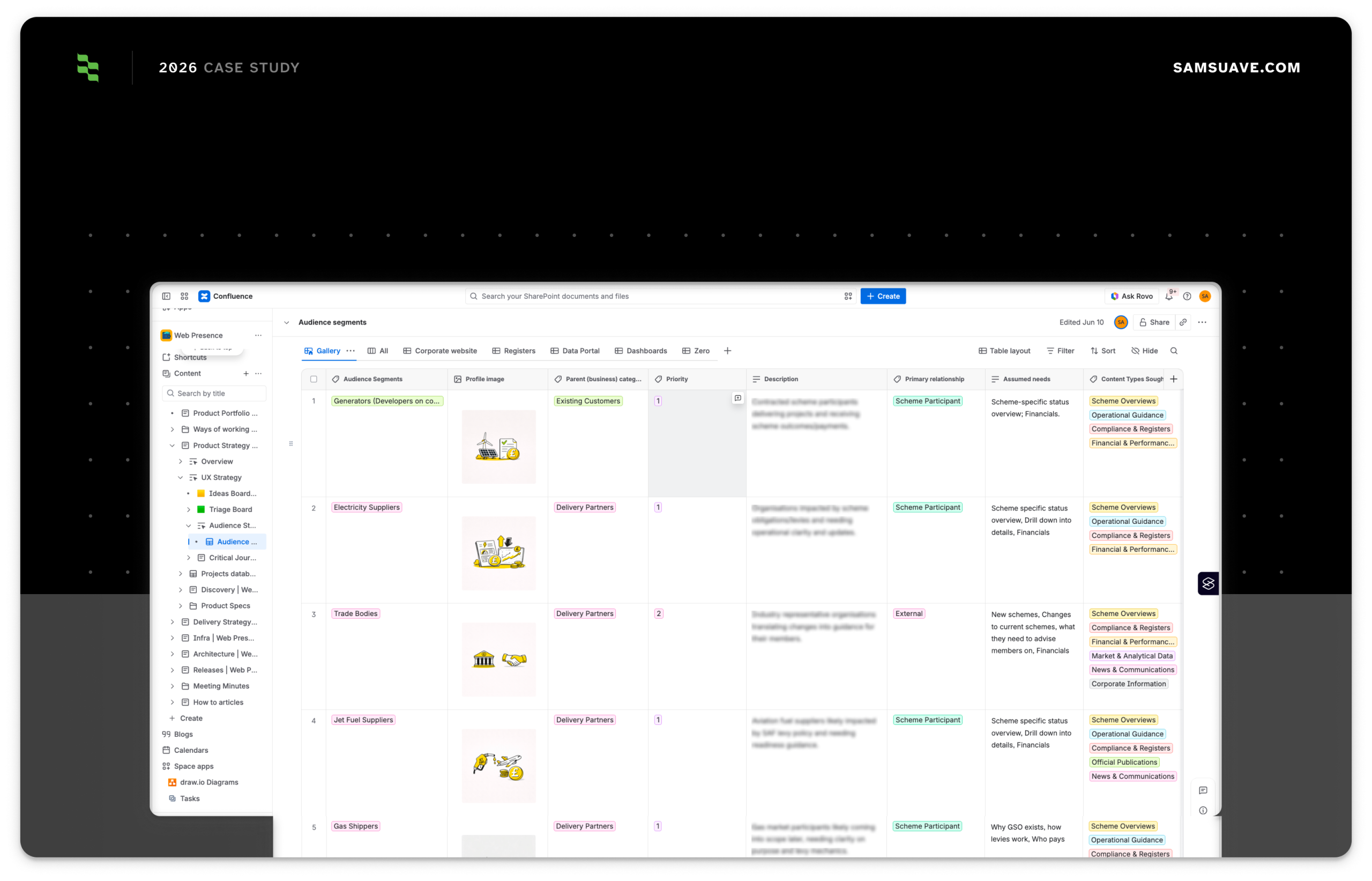
I developed a more granular working audience database that connected each segment to its parent business category, priority level, assumed needs, content types sought, relevant product touchpoints, related projects and confidence level. This made the estate easier to reason about.
It also exposed an important nuance: the same organisation could present different needs depending on the task at hand. A generator trying to confirm a compliance requirement is not performing the same job as an analyst looking for historic data, or a journalist seeking an authoritative statement.
From broad business segments to useful product context
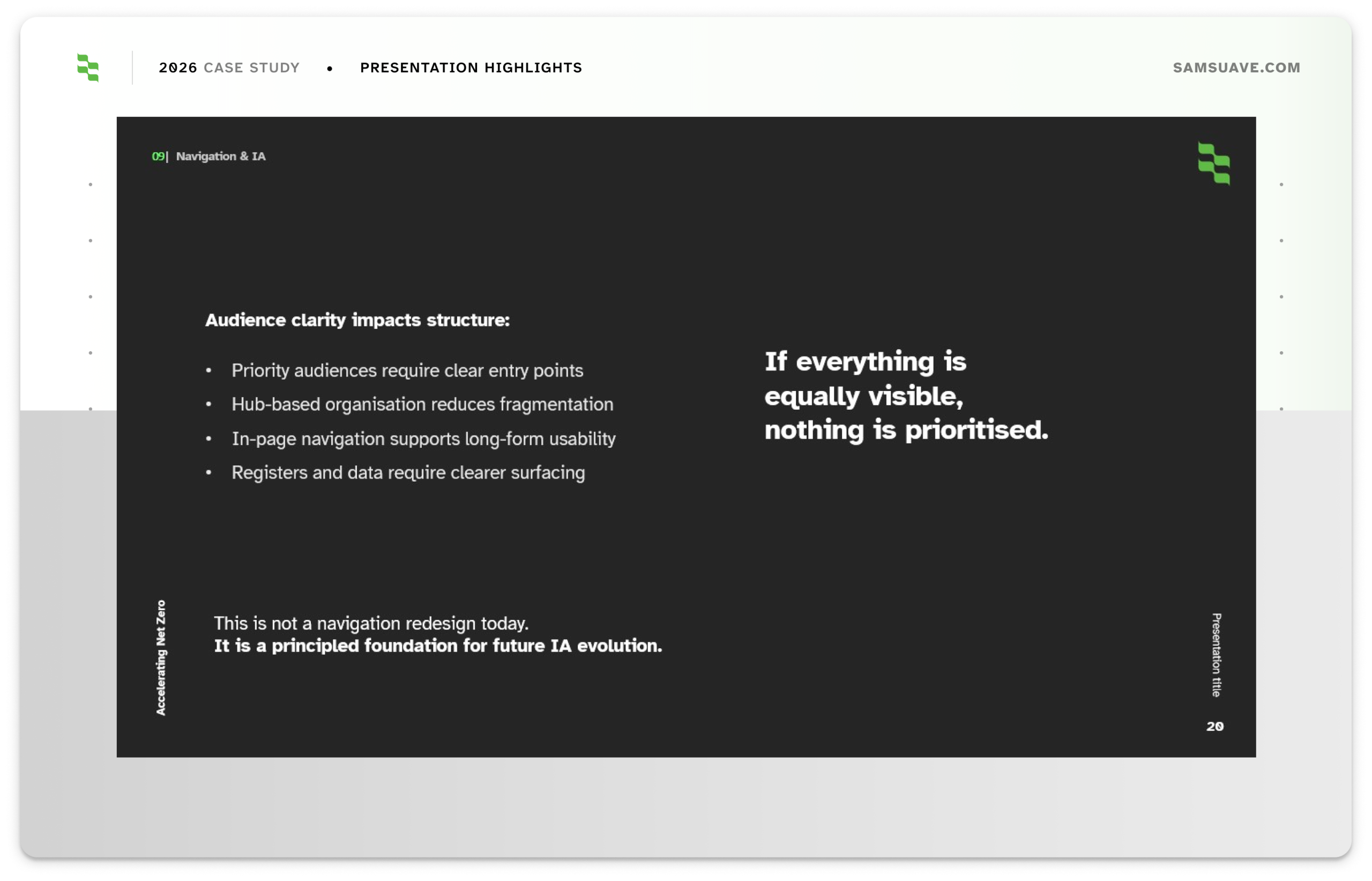
The most persistent problems were structural rather than volumetric.
People needed to find current guidance, understand scheme rules, locate levy rates, access registers and data, verify official statements, understand LCCC’s role and identify the correct next step.
The recurring friction included scattered entry points, fragmented archives, unclear versioning, terminology barriers, over-reliance on PDFs and inconsistent navigation patterns.
That changed the nature of the conversation.
Instead of asking:
“What content should we publish next?”
we could ask:
“What structure, journey or reusable pattern will help this audience achieve its goal?”
I also used AI during parts of the discovery process to help organise and synthesise a large volume of inputs. It accelerated the work, but it did not replace judgement. The interpretation, prioritisation and decisions remained my own.
Why this mattered for AI
This was the first layer of AI preparedness.
AI cannot reliably support users, or internal teams, if the organisation cannot articulate who the audience is, what the user is trying to achieve, which information is authoritative, what a good outcome looks like and where risk exists.
The audience and content work created a more grounded opportunity lens for future AI exploration.
Decision 2:
Model the estate as a connected service ecosystem
Once the audience baseline existed, I made a second decision.
I stopped treating Web Presence as a collection of separate websites and started modelling it as one connected service ecosystem.
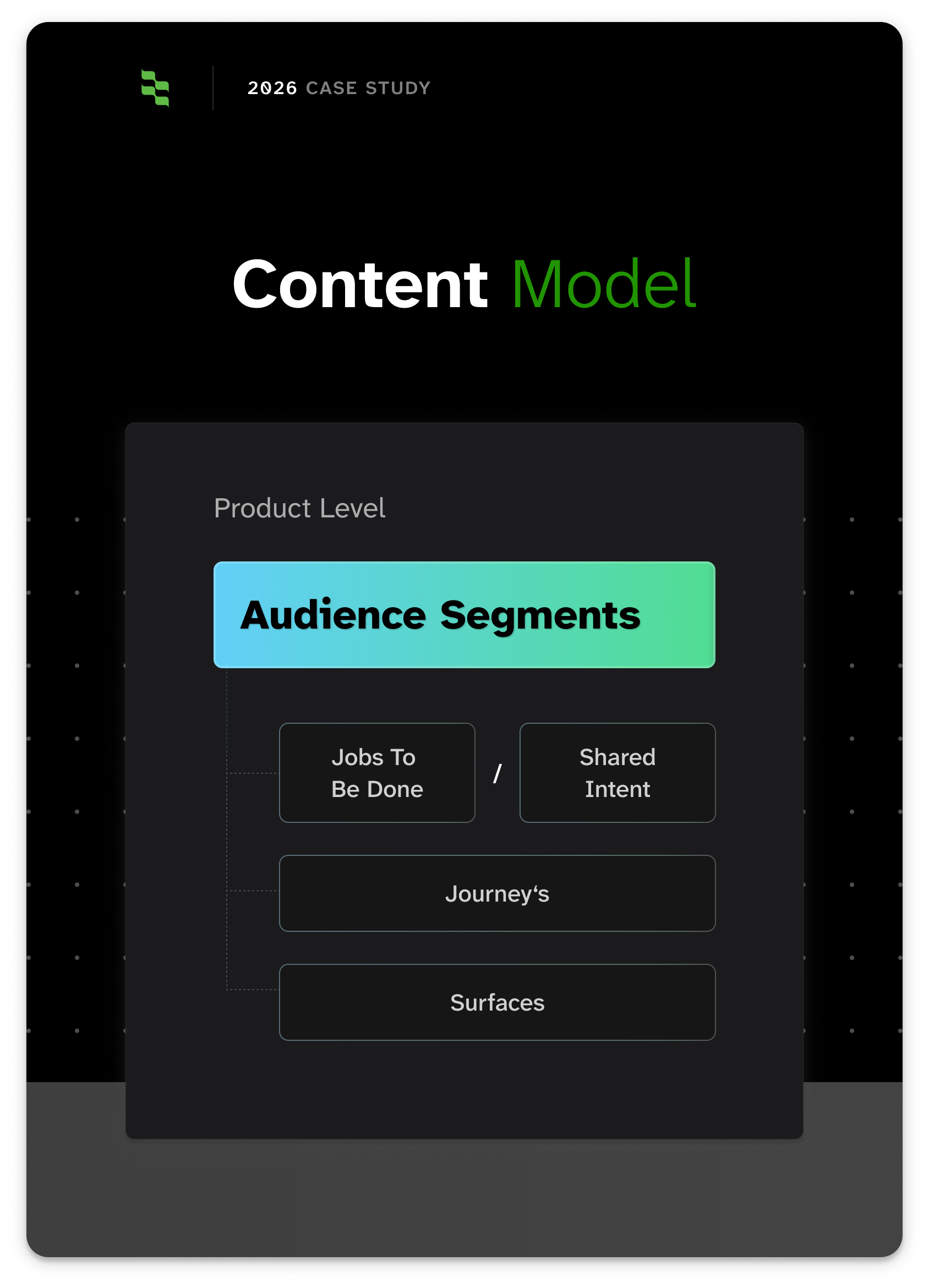
I created a shared model for content and journeys
Web Presence did not own every part of the end-to-end experience. But it still shaped how users were prepared for an action, guided towards relevant information, handed into adjacent services and supported when something went wrong.
That included journeys moving between public-facing products and operational tools such as Zero.
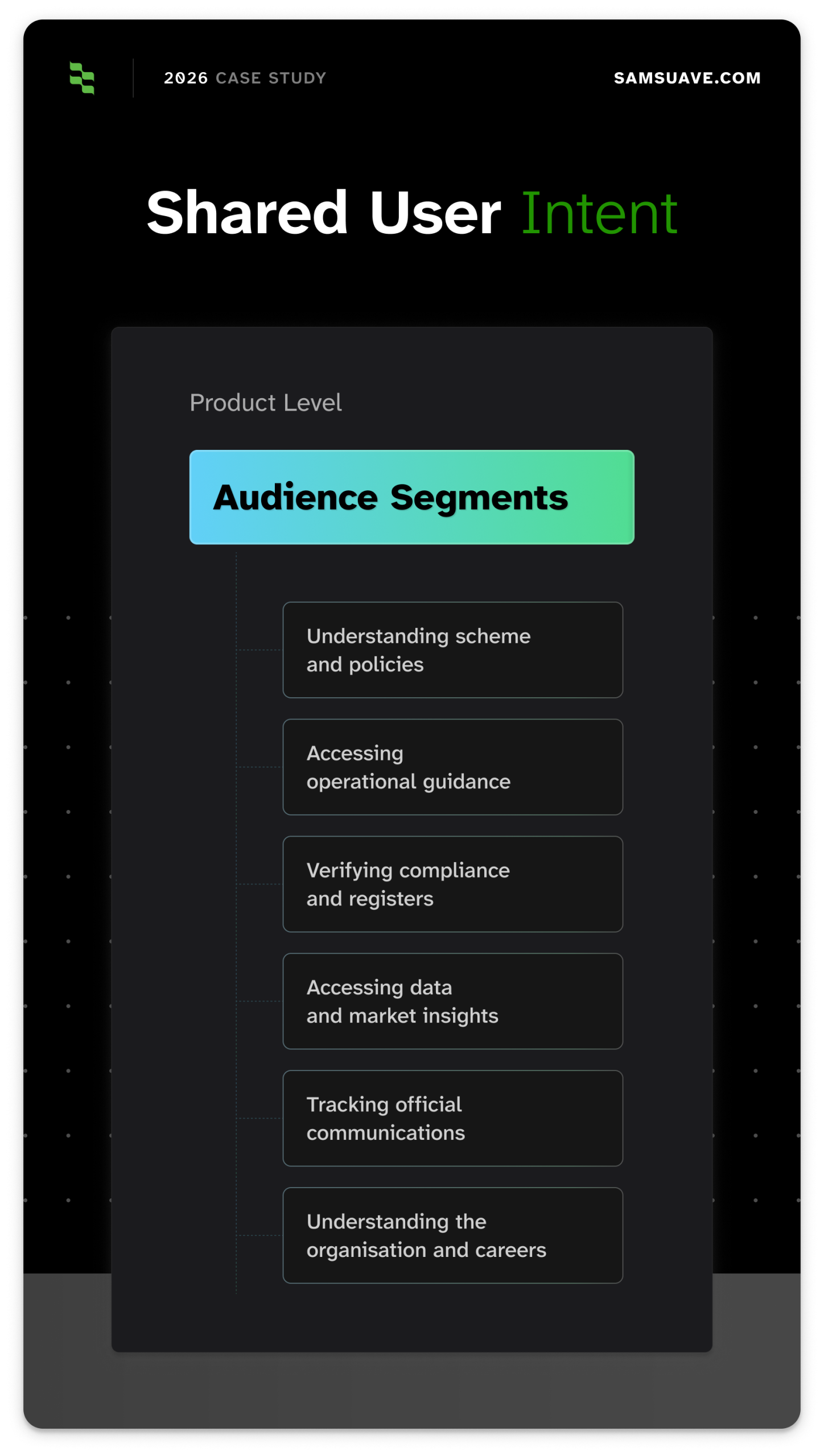
Shared intent instead of dozens of disconnected journeys
The audience database contained many granular groups. Designing a bespoke journey for each one would have created more complexity, not less.
I therefore clustered needs around shared intents such as:
- understanding schemes and policies
- accessing operational guidance
- verifying compliance and registers
- accessing data and market insights
- tracking official communications
- understanding the organisation and careers
This produced a smaller set of critical journeys representing the tasks the wider ecosystem needed to support well.
The critical-journey framework also made prioritisation more explicit. A journey could be considered critical because of organisational importance, compliance dependency, scheme-participant need, behavioural evidence, cross-product complexity or public-value risk.
Mapping the CfD lifecycle
I also initiated a CfD lifecycle map spanning pre-allocation activity, application preparation, auction, award and contract creation, onboarding, milestone delivery, construction and operations, payments and compliance, and ongoing support.
The map connected those stages to the Corporate Website, CfD Allocation Site, Data Portal, Registers, Dashboards, Zero and related offline processes.
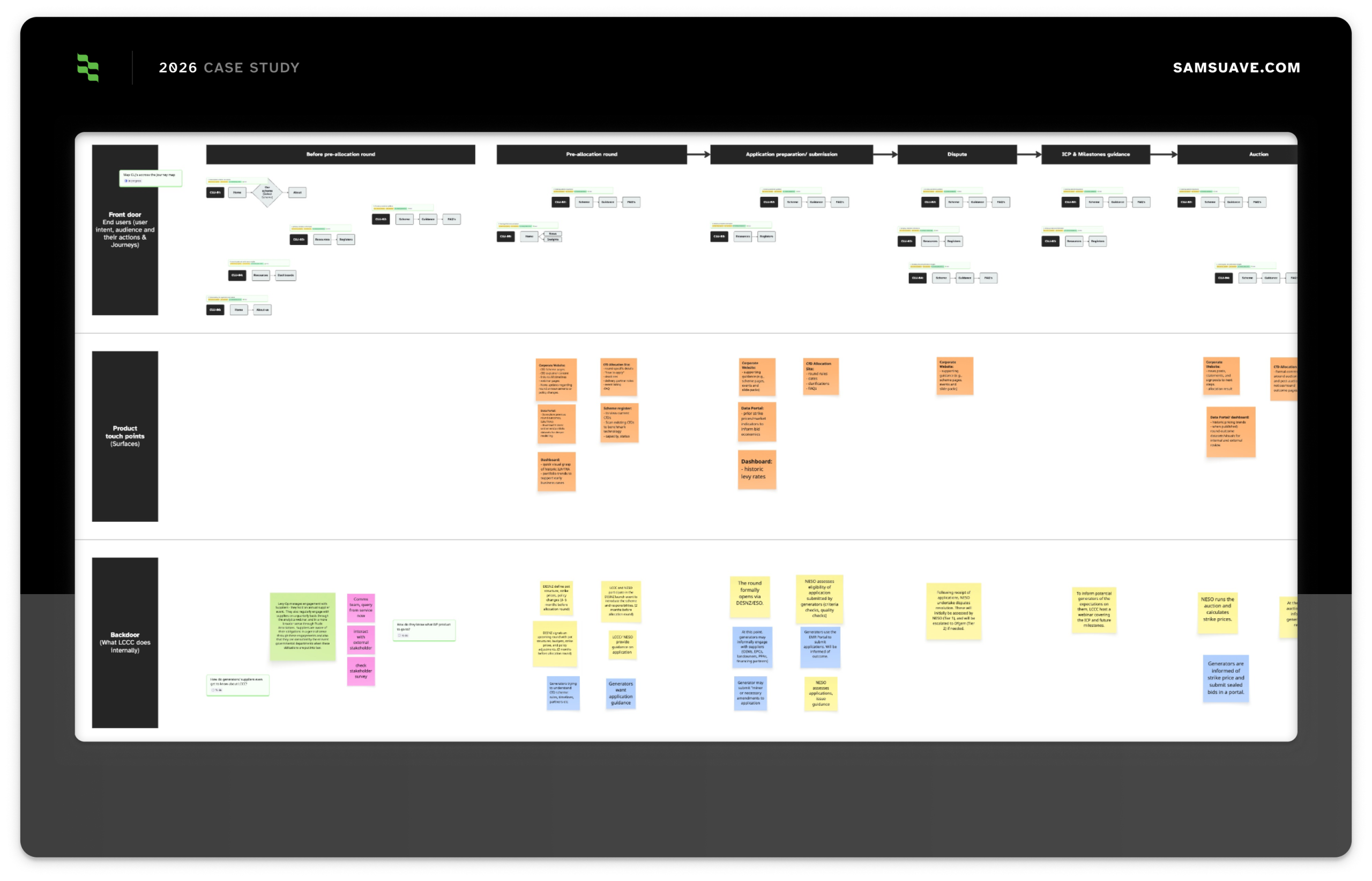
This changed the level at which design conversations could happen.
Instead of asking how an individual page should look, we could ask whether an audience had a clear entry point, whether hand-offs between products were intentional, what context was missing at a given milestone and where users were likely to lose confidence.
It also created a better frame for exploring where contextual assistance might add value, and where a deterministic interaction would remain safer.
This was the first layer of AI preparedness.
AI cannot reliably support users, or internal teams, if the organisation cannot articulate who the audience is, what the user is trying to achieve, which information is authoritative, what a good outcome looks like and where risk exists.
The audience and content work created a more grounded opportunity lens for future AI exploration.
Why this mattered for AI
The lifecycle model created a second layer of AI preparedness. AI should not be attached indiscriminately to pages. It should be considered within a real journey, with a clear audience, a clear task and a clear measure of success.
For example, a scheme participant may benefit from contextual guidance explaining where they are in a lifecycle, what matters at that stage, whether an action is required and which tool they need to use next.
That is a more credible front-stage opportunity than a generic chatbot.
The same journey context also exposes back-stage opportunities, such as helping teams identify relevant content, maintain consistency or support page creation against known patterns.
From foundations
to product design
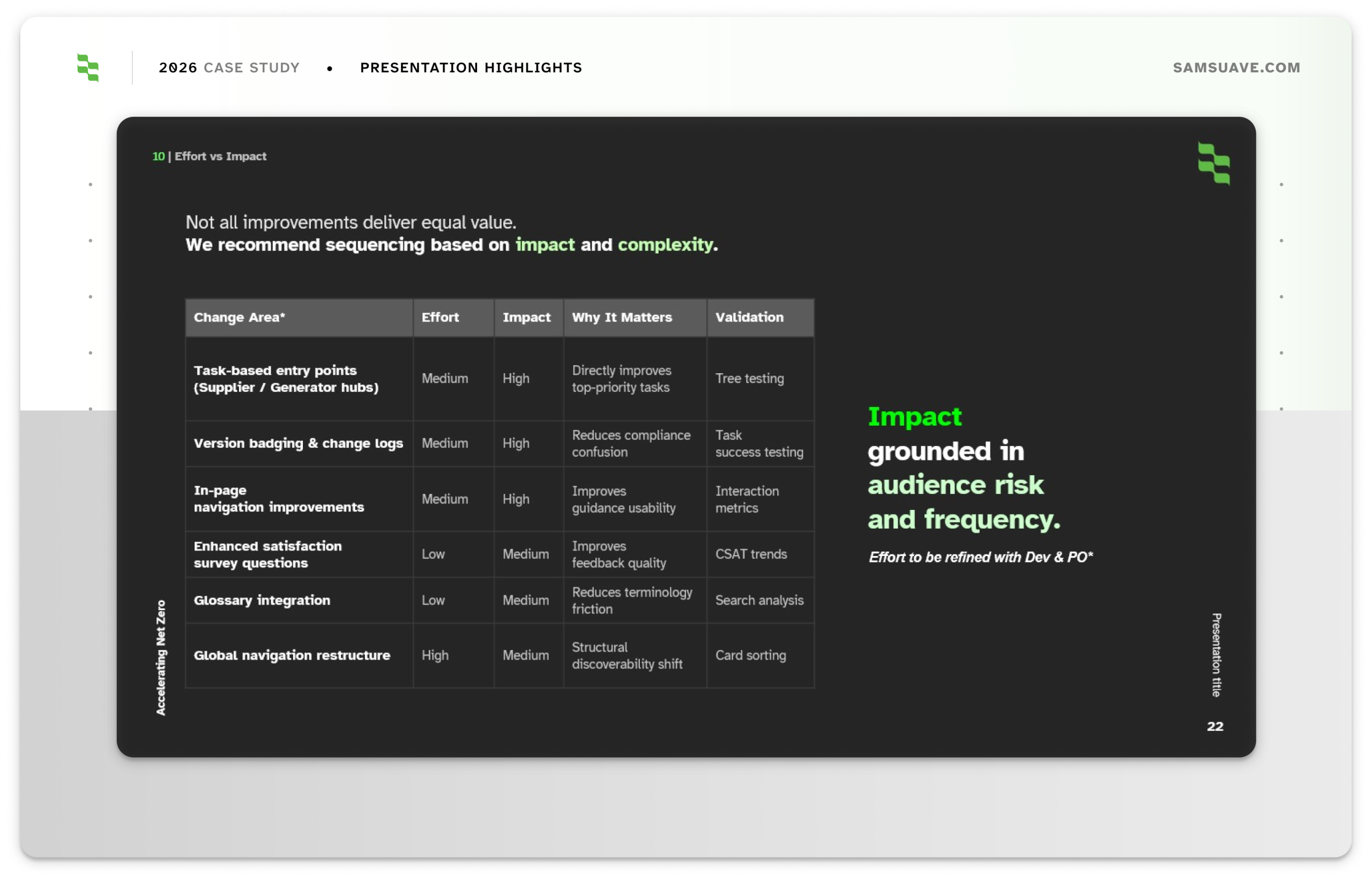
My third decision was to prevent the work ending as a static discovery report. This programme was intended to move the needle in the near term while creating a more coherent path into the future.
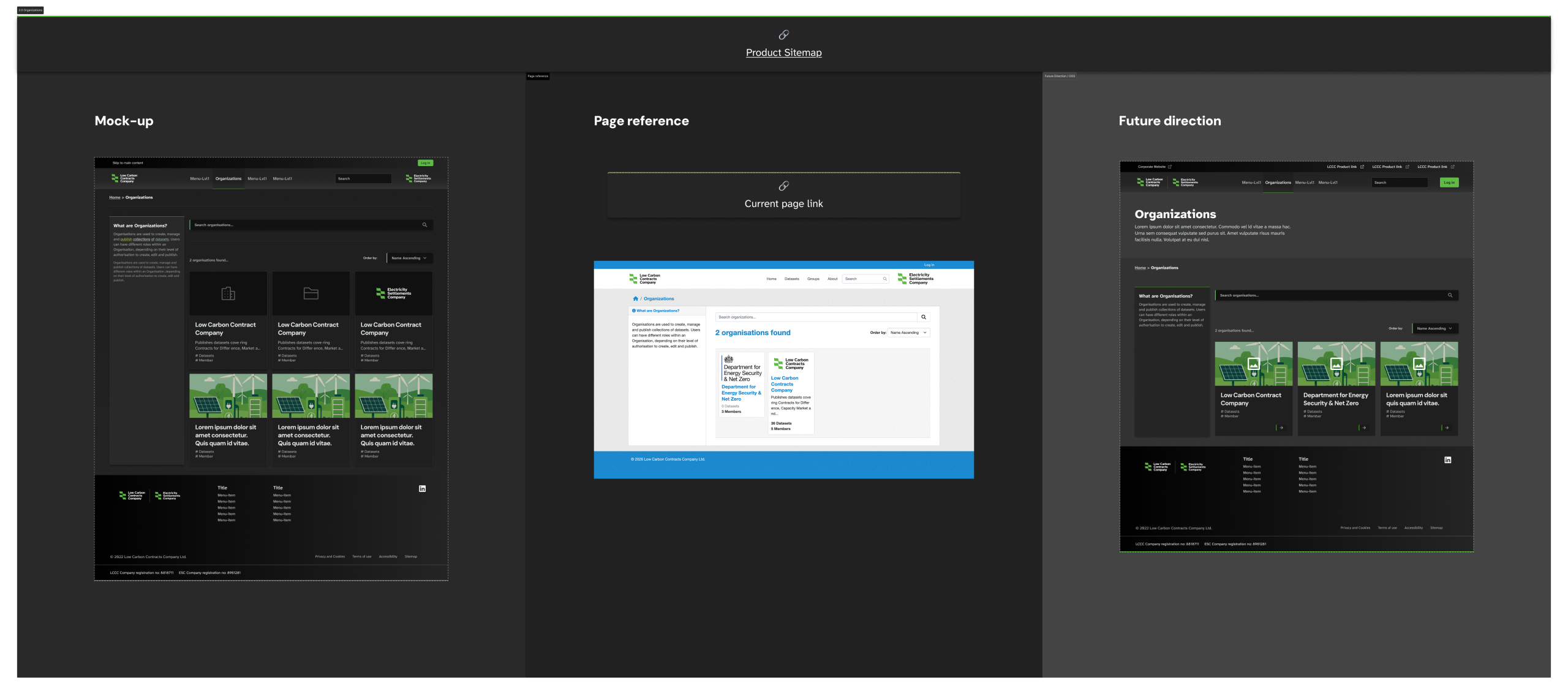
The discovery work shaped committed and emerging initiatives including Experience Uplift, landing-page signposting, navigation aligned to user intent, clearer access to data and registers, a Data Resource Centre, CfD timeline improvements, scheme-driven notifications, content clarity and trust signals, and a more consistent set of UI foundations.
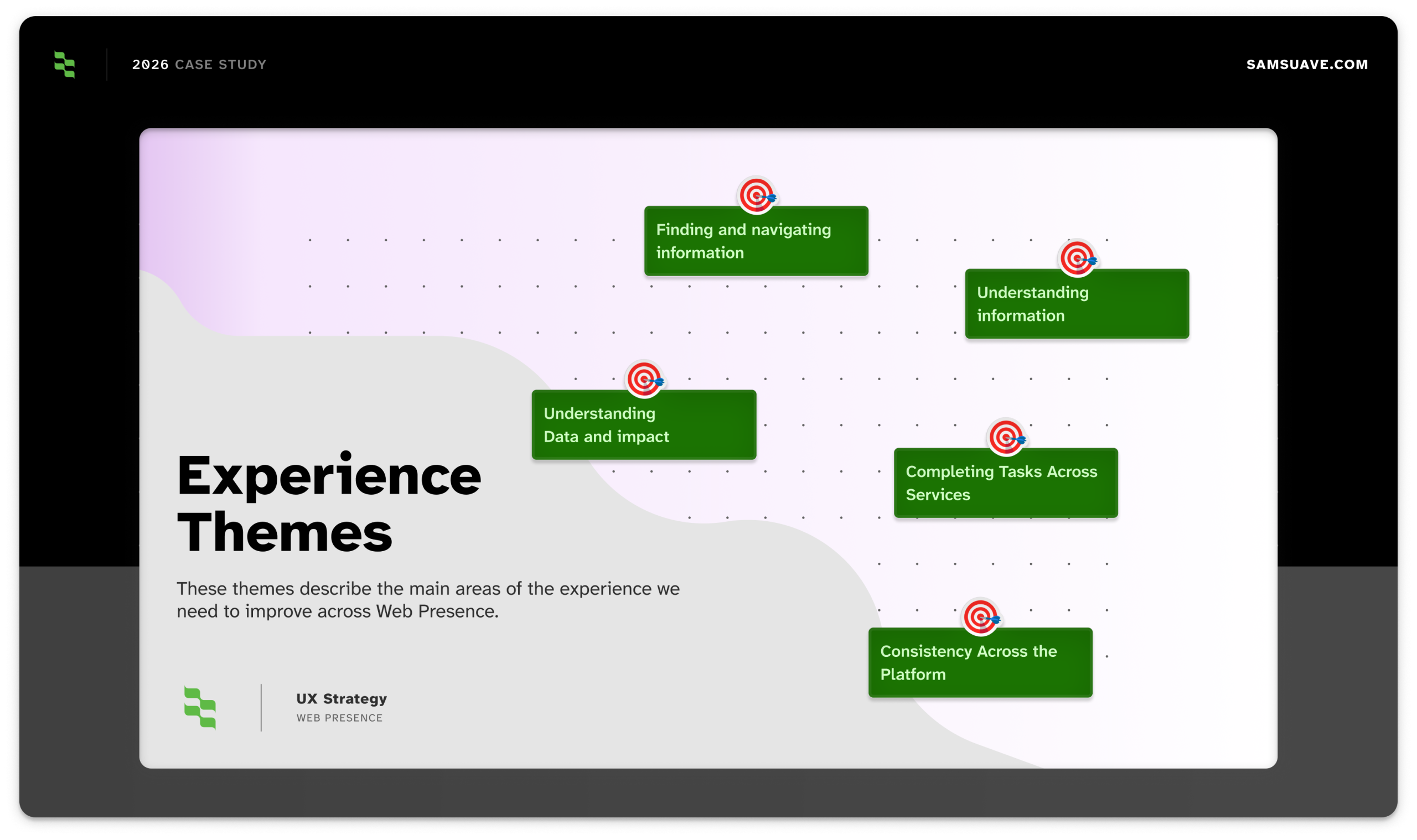
Connecting strategy to delivery
I codified the emerging direction in a Web Presence UX Strategy.
The strategy defined five experience themes:
- Finding and Navigating Information
- Understanding Information
- Understanding Data and Impact
- Completing Tasks Across Services
- Consistency Across the Platform
These themes connected the Product Vision to active and emerging initiatives such as IA Uplift, Data Resource Centre, Content Model v1, Design System and UI Foundations, Insights Experience and AI Knowledge Access.
Then I mapped this to the CfD Blueprint providing a meta lens within a Birds Eye lens.
This gave the team a clearer way to cluster requests, interpret BAU work as signals and decide which issues warranted deeper shaping.
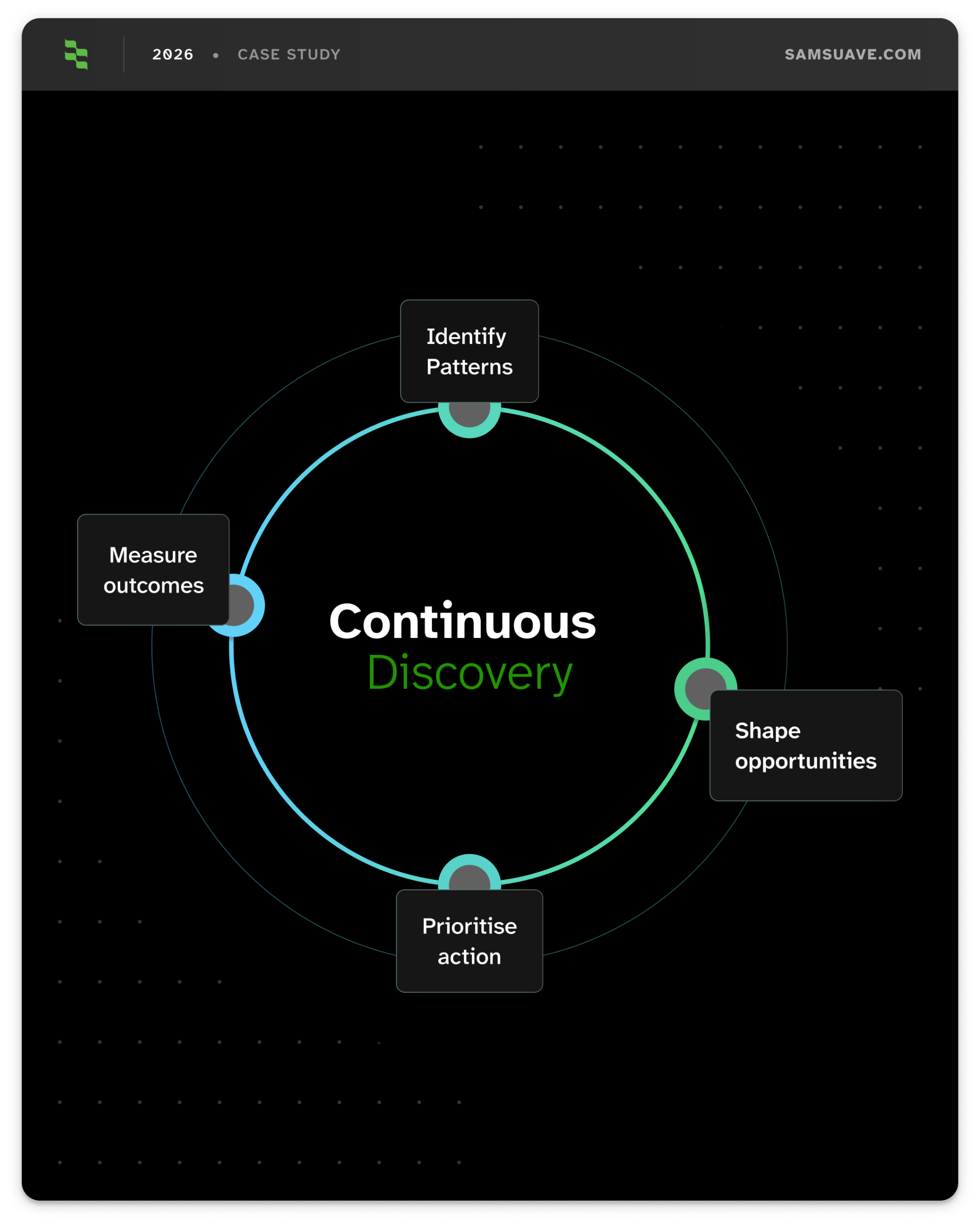
Building a continuous
evidence loop
I then connected the strategy to a Continuous Discovery model
The model brought together Product Panel research, behavioural monitoring, engagement surveys, stakeholder feedback, critical-journey reviews, usability testing, Content Discovery findings and BAU ideas.
This created a route from evidence to roadmap decisions, while making it easier to challenge assumptions before they hardened into delivery work.
Introducing journey-level measurement
Existing NPS data offered a broad sentiment signal, but it could not explain where a journey was failing.
I began defining a more targeted approach based on CUJ’s, using event triggers; this would give us capabilities like journey-health monitoring, diagnostic analytics, Clarity (a tool for behavioural analytics) recordings, qualitative feedback and Product Panel validation.
- For public-facing Web Presence experiences, HEART provides a useful default measurement lens.
- For must-complete scheme-participant pathways, CASTLE-informed measures may also be appropriate where confidence, learnability, efficiency and task success matter more than generic engagement.
Because instrumentation was still being established, I treated the early work as baseline-building rather than evidence of long-term uplift. The value was not a prematurely claimed metric. It was the creation of a measurement model the team could continue using after I left.
Codifying design intent
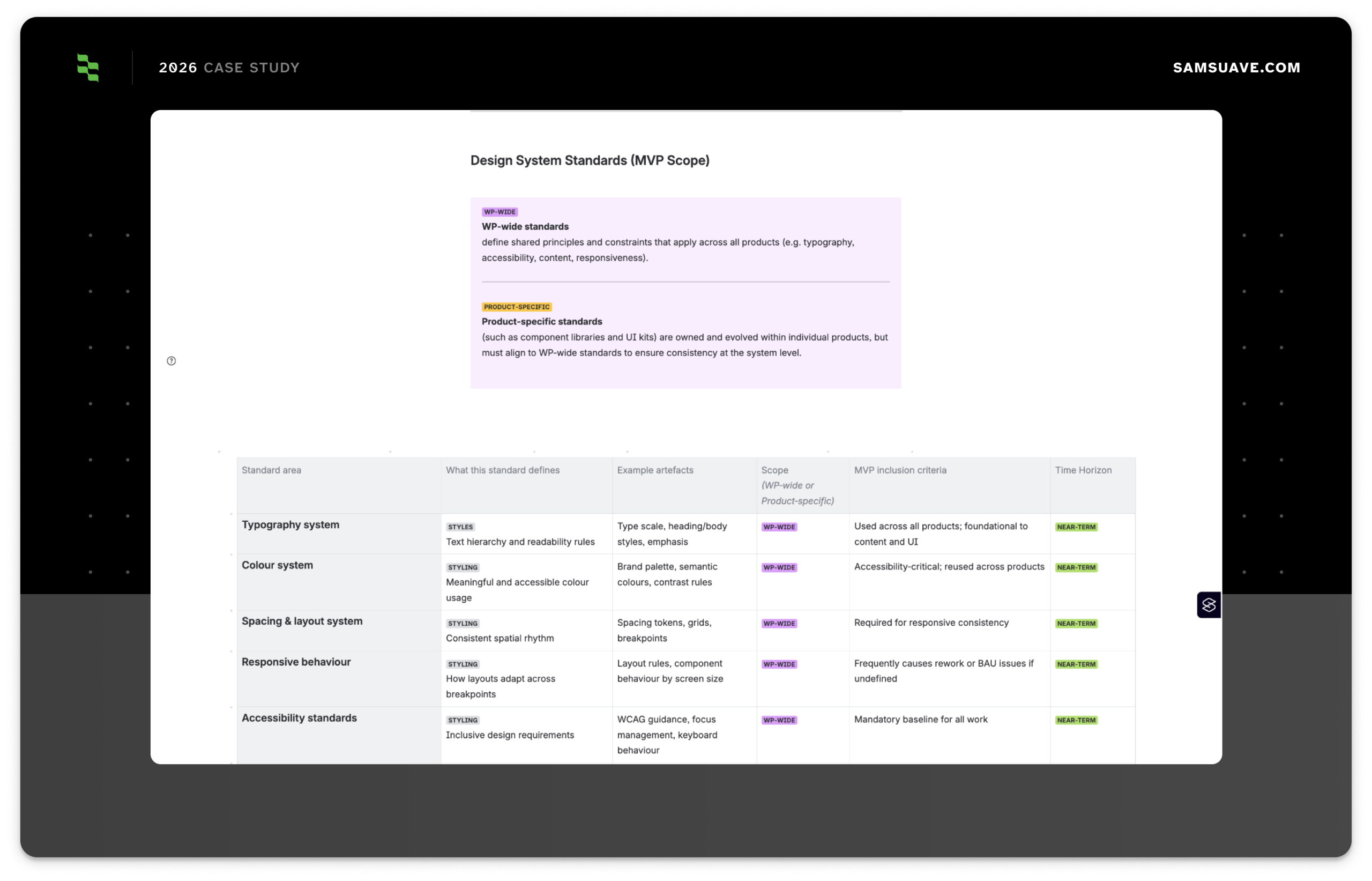
I also began shaping a lean Design System MVP.
The immediate goal was practical: reduce design drift, improve accessibility, clarify responsive behaviour, reduce duplicated effort and make hand-offs more predictable.
The documentation separated WP-wide standards from product-specific standards and outlined a roadmap covering typography, semantic colour, spacing and layout, responsive behaviour, accessibility, UI patterns, content patterns, microcopy, data formatting, interaction states, components, UI kits and lightweight governance.
This wasn‘t simply a component-library exercise, It was a way of codifying what good looked like across the estate in the context of shared intent.
Why this mattered for AI
This created a third layer of AI preparedness. If AI is used to support page creation, content generation, design iteration or service operations, it needs curated context.
Without codified standards, AI can accelerate inconsistency. With them, AI-assisted workflows can be grounded in brand, accessibility, content structure, approved patterns, interaction behaviour, component constraints, governance, audience context and user intent.
The longer-term design-system roadmap was therefore not just about reusable components. It created the basis for AI-assisted workflows that could understand, recommend, validate and support design-system usage over time.
One potential application was page building. If CASE authors were supported by AI when creating or refining pages, the quality of that assistance would depend heavily on the system beneath it: approved templates, content rules, accessibility expectations, design patterns and clear boundaries around what could be generated safely.
That is the difference between using AI as a shortcut and preparing an organisation to use it well.
From foundations
to product design
This programme was intended to move the needle in the near term while creating a more coherent path into the future.
The discovery work shaped committed and emerging initiatives including Experience Uplift, landing-page signposting, navigation aligned to user intent, clearer access to data and registers, a Data Resource Centre, CfD timeline improvements, scheme-driven notifications, content clarity and trust signals, and a more consistent set of UI foundations.
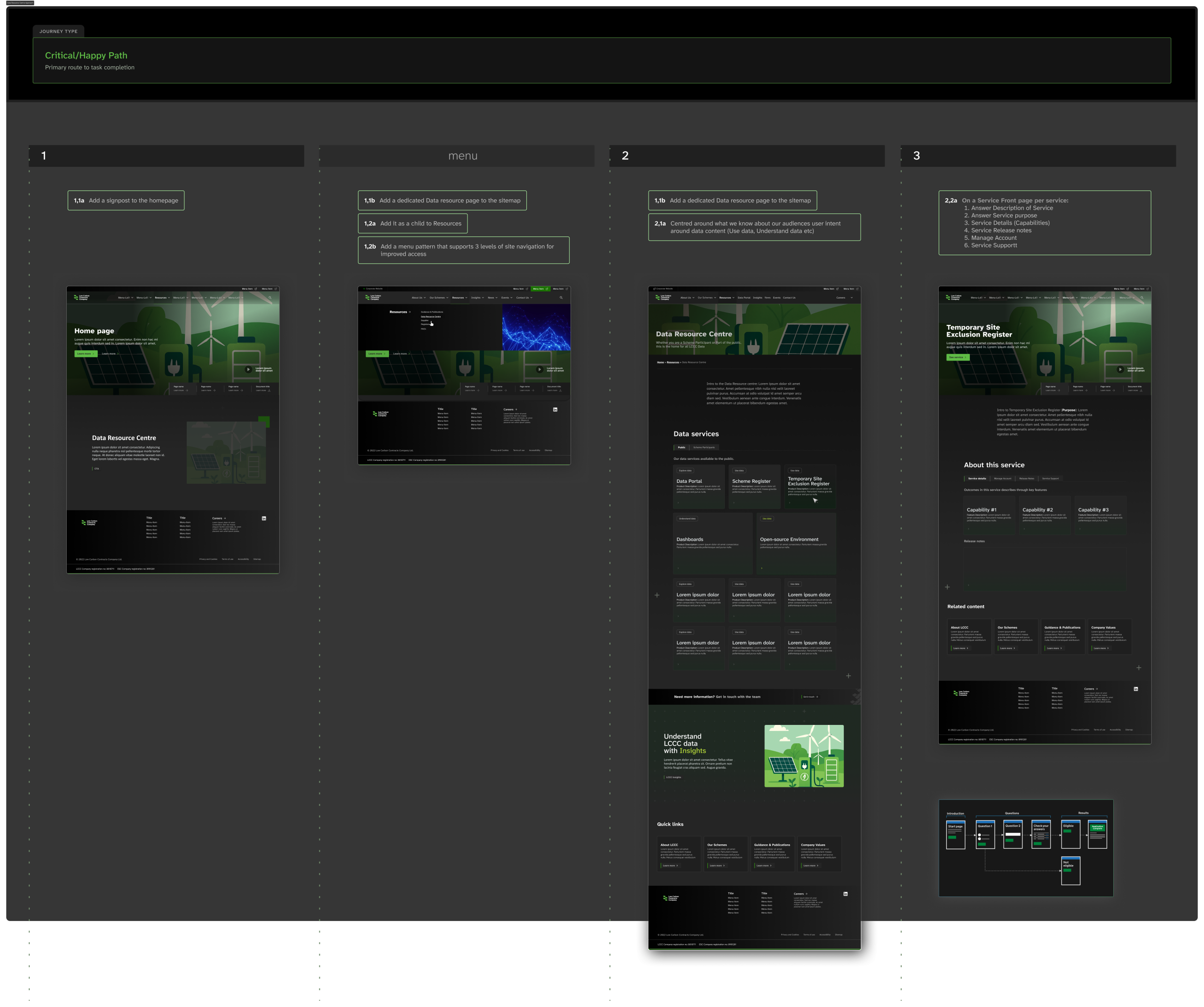
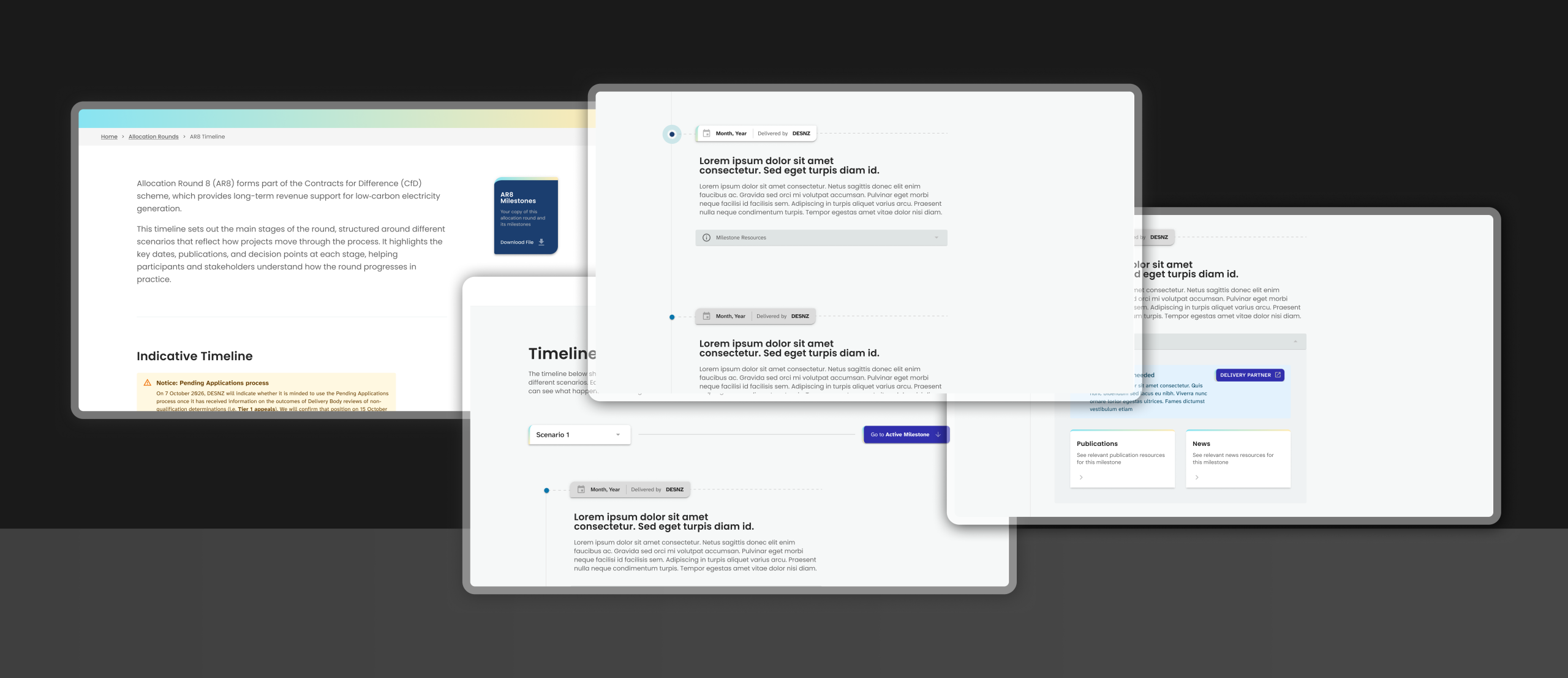
The CfD timeline and notification-wrapper concepts are especially relevant because they connect the strategic and interface layers.
They explore a practical question:
“How might we help scheme participants understand where they are, what matters now and where they need to act across a fragmented service ecosystem?“
This is also the kind of narrow AI-enabled opportunity that can be prototyped, tested and measured rather than assumed.
The Data Resource Centre creates a complementary opportunity. LCCC already publishes a significant amount of public data across dashboards, datasets, registers and APIs. The challenge is not simply to expose more information. It is to help different audiences understand what exists, find the right entry point and move between exploration, interpretation and action with less friction.
Introducing journey-level measurement
Existing NPS data offered a broad sentiment signal, but it could not explain where a journey was failing.
I began defining a more targeted approach based on CUJ’s, using event triggers; this would give us capabilities like journey-health monitoring, diagnostic analytics, Clarity (a tool for behavioural analytics) recordings, qualitative feedback and Product Panel validation.
- For public-facing Web Presence experiences, HEART provides a useful default measurement lens.
- For must-complete scheme-participant pathways, CASTLE-informed measures may also be appropriate where confidence, learnability, efficiency and task success matter more than generic engagement.
Because instrumentation was still being established, I treated the early work as baseline-building rather than evidence of long-term uplift. The value was not a prematurely claimed metric. It was the creation of a measurement model the team could continue using after I left.
Codifying design intent
I also began shaping a lean Design System MVP.
The immediate goal was practical: reduce design drift, improve accessibility, clarify responsive behaviour, reduce duplicated effort and make hand-offs more predictable.
The documentation separated WP-wide standards from product-specific standards and outlined a roadmap covering typography, semantic colour, spacing and layout, responsive behaviour, accessibility, UI patterns, content patterns, microcopy, data formatting, interaction states, components, UI kits and lightweight governance.
This wasn‘t simply a component-library exercise, It was a way of codifying what good looked like across the estate in the context of shared intent.
Why this mattered for AI
This created a third layer of AI preparedness. If AI is used to support page creation, content generation, design iteration or service operations, it needs curated context.
Without codified standards, AI can accelerate inconsistency. With them, AI-assisted workflows can be grounded in brand, accessibility, content structure, approved patterns, interaction behaviour, component constraints, governance, audience context and user intent.
The longer-term design-system roadmap was therefore not just about reusable components. It created the basis for AI-assisted workflows that could understand, recommend, validate and support design-system usage over time.
One potential application was page building. If CASE authors were supported by AI when creating or refining pages, the quality of that assistance would depend heavily on the system beneath it: approved templates, content rules, accessibility expectations, design patterns and clear boundaries around what could be generated safely.
That is the difference between using AI as a shortcut and preparing an organisation to use it well.
What I
left behind
The work did not result in one finished redesign, and I would not frame it that way.
It created a stronger decision-making system.
- a rebrand applied across the public-facing estate
- Content Discovery research and synthesis
- an audience database
- stakeholder playback
- an initial critical-journey framework
- a working UX Strategy
- downstream Jira epics and clustered delivery opportunities
- shared audience language
- a task-based content model
- a shared-intent framework
- a CfD lifecycle view
- experience themes
- clearer traceability from business goals into projects
- a Continuous Discovery operating model
- a Design System MVP direction
- a design-standards scope
handed over 0
- CUJ monitoring and instrumentation
- Product Panel planning
- Data Monitoring planning
- ongoing CfD lifecycle-map development
- the IA and Experience Uplift programme
- Data Resource Centre exploration
- AI opportunity-framing discussions
- contextual scheme-participant guidance
- scheme-driven notifications
- AI-assisted page building against curated standards
- AI-assisted design-system recommendation and validation
- selective use of AI to simplify journeys where evidence supports it
Programme by
the numbers.
systems now happens in one flow.
Faster Review cycles
internal validation tests.
Unified workflow
with a single end-to-end flow.
Data mismatches
statements after redesign.
In monthly settlements
through redesigned interface.
Reflection & Learning
The most important lesson was that AI readiness does not begin with technology. It begins with understanding users, intent, journeys, authoritative information, design quality and measurable outcomes.
Traditional product design already struggles when teams move too quickly from assumptions to solutions. AI can compound that problem by making it possible to build the wrong things faster.
The more responsible path is to first make the product legible, measurable and governable.
Then AI can be treated for what it is: a tool and a design material whose value should be demonstrated against real user and business outcomes.